Redefining
Enterprise
Onboarding
Intelex's document import process was broken by design. Client onboarding stretched to 6 months at its worst, burning consultant hours and eroding trust. I redesigned the experience from the ground up.

The outcome
From NO to WOAH!!
Before
17%
Customer satisfaction on CSAT — critically low, signalling systemic friction in the onboarding experience.
After
92%
Customer satisfaction post-redesign — eliminating the friction points that blocked client success.
Impact
441%
Increase in customer satisfaction on CSAT — one of the most significant UX-driven improvements in Intelex history.
Measuring Impact
Working with my UX colleauge Ashley Di Battista, we validated the measurement approach. She caught a critical framing issue: the draft metric didn't reflect the severity of the problem my team inherited.
The correction
Client satisfaction was at 17% when we started — not 62%. The system wasn't underperforming. It was broken.
Validated metrics
CSAT: 17% → 92% · 441% relative increase
Time to value: 6 months → 72 hours · 98% reduction
Here's the solution.
After months of discovery, blueprinting, and iteration — a new document import experience that cut time-to-value from six months down to days.
Paste a Vimeo URL into the video control to embed
Replace a broken import process and restore client confidence
As UX Designer, my goal was to replace the outdated document import control process with a new, efficient system. The previous approach relied on a combination of two legacy projects, creating a fragile, error-prone experience that hurt clients and the business alike.
Working with the Product Owner, Lead Developer, and dev team, we developed a new system focused on ease of use, reliability, and effective support for document and metadata import — reducing time-to-value for every new client.
Product Owner · UX Researcher · UX Designer (Me) · Engineering Lead · Dev team
Identifying the core problems through research & discovery
Through surveys and interviews, we discovered critical issues and trends. This deep understanding allowed us to develop targeted strategies to tackle the challenges head-on.
Up to 6 Months
to Go Live
Getting documents, files, and client data ready for import into the Intelex platform would take weeks, and in worst cases up to 6 months — long before clients saw any value from their purchase.
Unbillable Hours
Piling Up
Customer support team agents were consumed by clients unable to get documents into the system. Constant back-and-forth between CST and clients compounded delays and costs at every step.
 Enlarge
"Before UX involvement, user adoption was low. Releases would come back needing an improvement package, or we find out 6 months later that the direction wasn't working for clients." — Matt Conquer, Product Owner
Activities & Outputs
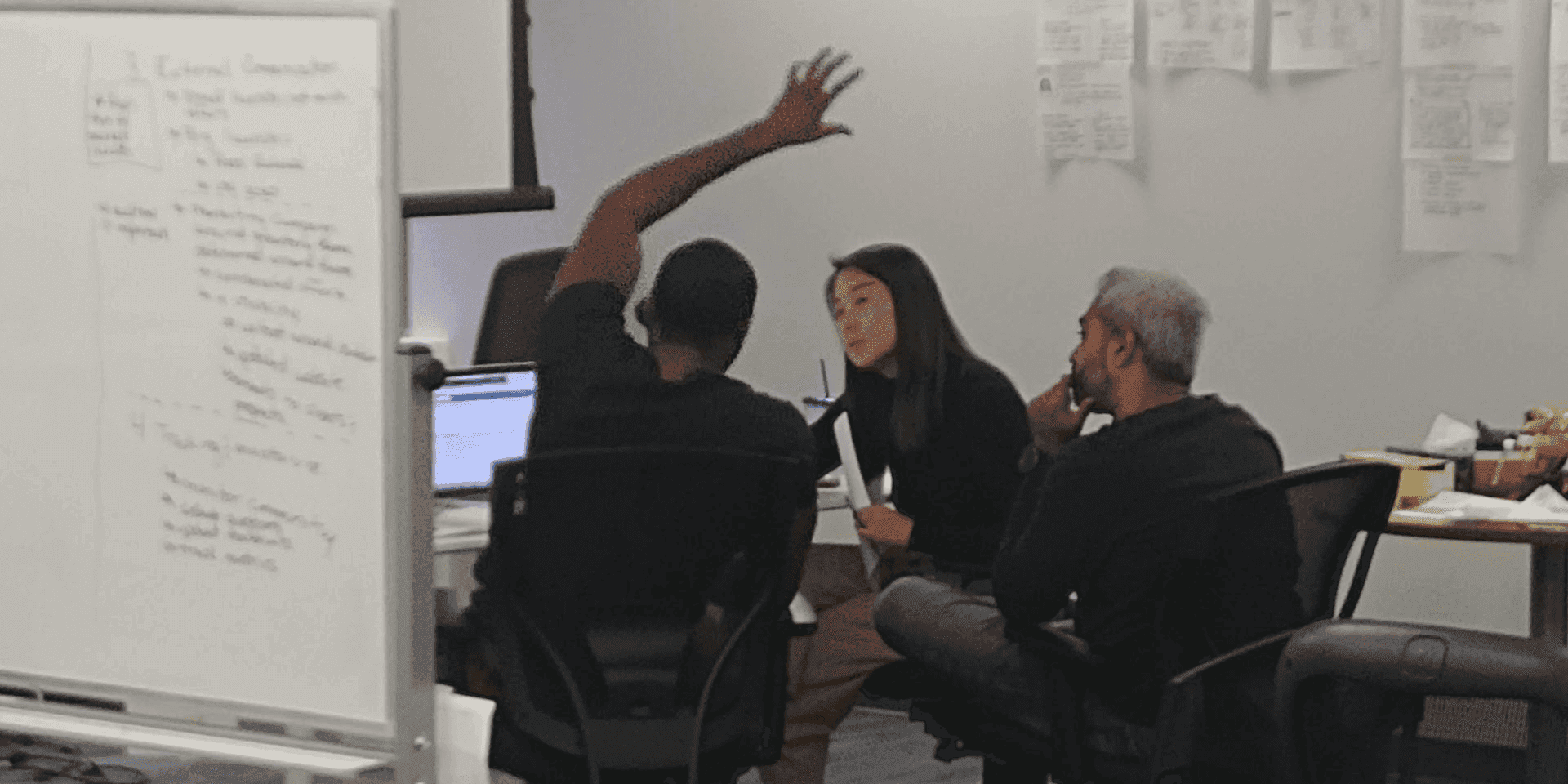
Our UX Research Lead Vicky led the research effort while I focused on root cause analysis. Together we ran blueprinting workshops with leads across Product, Research, and Engineering — building a shared understanding that let us move faster with confidence.
 Enlarge
The current [document import] process forces users to adapt to old and clunky V5, neglecting the need for a quick and accurate way to import documents. Our product will close this gap by building a user-focused importing process — with end-users receiving appropriate feedback within reasonable time.
"A visual journey of our discovery and ideation process, capturing the evolving understanding of user needs and workflows."
"Flow notes of old version V5 by our dev lead team, laying the groundwork for seamless integration and development."
Breathing
New Life In
To kick off the concept ideation phase, we defined design principles that required the experience to be autonomous, adaptive, and integrated.
"We needed a more holistic experience that allowed users to discover related content to support their learning journey."
Autonomous
Empower users to self-serve through clear, guided workflows that reduce dependence on support agents at every step of the import process.
Adaptive
Cater to diverse client contexts and data structures, ensuring the system handles variation gracefully without forcing users to bend to legacy constraints.
Integrated
Seamlessly connect documents, metadata, and feedback loops so the experience feels cohesive — not like a bolt-on import tool grafted onto a legacy system.
Further, Higher, Faster — together
I am extremely proud of this project and its growth. The dev team's willingness to step outside their comfort zone was commendable — it allowed us to ask different, critical questions that drove progress even further.
The team's thorough assessment of the current state was a vital step toward success. Though it took time, confidence grew as our shared understanding deepened — making it much easier to plan forward and break down the blueprint maps into future state scenarios.
The strong bond formed with Matt, the Product Owner, through our team sessions was a crucial element in our success. Transparency around approaches, perspectives, and goals let us align, share, and plan the trajectory of the project together.
Paste a Vimeo URL into the video control to embed
A Video I Produced for the Product Town Hall
I conceived, scripted, and produced a short film presented at the Product Town Hall — showcasing how we shifted from a sales-driven model to one deeply rooted in the voice of the customer and UX methodologies.
This video was a turning point — sparking broader discussions and encouraging process improvements across the company. It broke down silos, promoted transparency, and empowered teams to adopt more agile practices — fostering a culture of collaboration and continuous improvement.
Voices from the team
The project's success was built on trust, transparency, and a shared commitment to the user. Here's how the people who were there describe the experience.
"Before UX involvement, user adoption was low. But using the UX playbook guided by Chris and Vicky, we captured user feedback early to level set and build our foundations out with greater confidence, and defensible evidence that justified our team direction."
"He brings a passion to everything he does, which is infectious. Chris is driven by a desire to keep digging deep into the hows and whys of every initiative. He is fearless even when tackling something new. He is definitely a strong value add to any UX organization."
"Chris is a passionate designer with excellent interpersonal skills who always strives to make the design process transparent and welcoming. I can always rely on Chris to deliver on-time and to a high standard — no matter the complexity or ambiguity."
Designing Success
Take a look at how I collaborate with teams across diverse industries — bridging research, strategy, and craft to ship products that matter.
Redefining
Enterprise
Onboarding
Intelex's document import process was broken by design. Client onboarding stretched to 6 months at its worst, burning consultant hours and eroding trust. I redesigned the experience from the ground up.
The outcome
From NO to WOAH!!
Before
17%
Customer satisfaction on CSAT — critically low, signalling systemic friction in the onboarding experience.
After
92%
Customer satisfaction post-redesign — eliminating the friction points that blocked client success.
Impact
441%
Increase in customer satisfaction on CSAT — one of the most significant UX-driven improvements in Intelex history.
Measuring Impact
Working with my UX colleauge Ashley Di Battista, we validated the measurement approach. She caught a critical framing issue: the draft metric didn't reflect the severity of the problem my team inherited.
The correction
Client satisfaction was at 17% when we started — not 62%. The system wasn't underperforming. It was broken.
Validated metrics
CSAT: 17% → 92% · 441% relative increase
Time to value: 6 months → 72 hours · 98% reduction
Here's the solution.
After months of discovery, blueprinting, and iteration — a new document import experience that cut time-to-value from six months down to days.
Replace a broken import process and restore client confidence
As UX Designer, my goal was to replace the outdated document import control process with a new, efficient system. The previous approach relied on a combination of two legacy projects, creating a fragile, error-prone experience that hurt clients and the business alike.
Working with the Product Owner, Lead Developer, and dev team, we developed a new system focused on ease of use, reliability, and effective support for document and metadata import — reducing time-to-value for every new client.
Product Owner · UX Researcher · UX Designer (Me) · Engineering Lead · Dev team
Identifying the core problems through research & discovery
Through surveys and interviews, we discovered critical issues and trends. This deep understanding allowed us to develop targeted strategies to tackle the challenges head-on.
Up to 6 Months
to Go Live
Getting documents, files, and client data ready for import into the Intelex platform would take weeks, and in worst cases up to 6 months — long before clients saw any value from their purchase.
Unbillable Hours
Piling Up
Customer support team agents were consumed by clients unable to get documents into the system. Constant back-and-forth between CST and clients compounded delays and costs at every step.
Enlarge"Before UX involvement, user adoption was low. Releases would come back needing an improvement package, or we find out 6 months later that the direction wasn't working for clients." — Matt Conquer, Product Owner
Activities & Outputs
Stakeholder & user interviews, problem statement workshop
Root cause analysis, VOC research, target customer mapping
Cross-functional workshops with Product, Research & Engineering
Impact & effort analysis, vertical slicing with Product Owner
Task flow concept, design principles definition
Mid-to-high fidelity flow in Adobe XD
Our UX Research Lead Vicky led the research effort while I focused on root cause analysis. Together we ran blueprinting workshops with leads across Product, Research, and Engineering — building a shared understanding that let us move faster with confidence.
Enlarge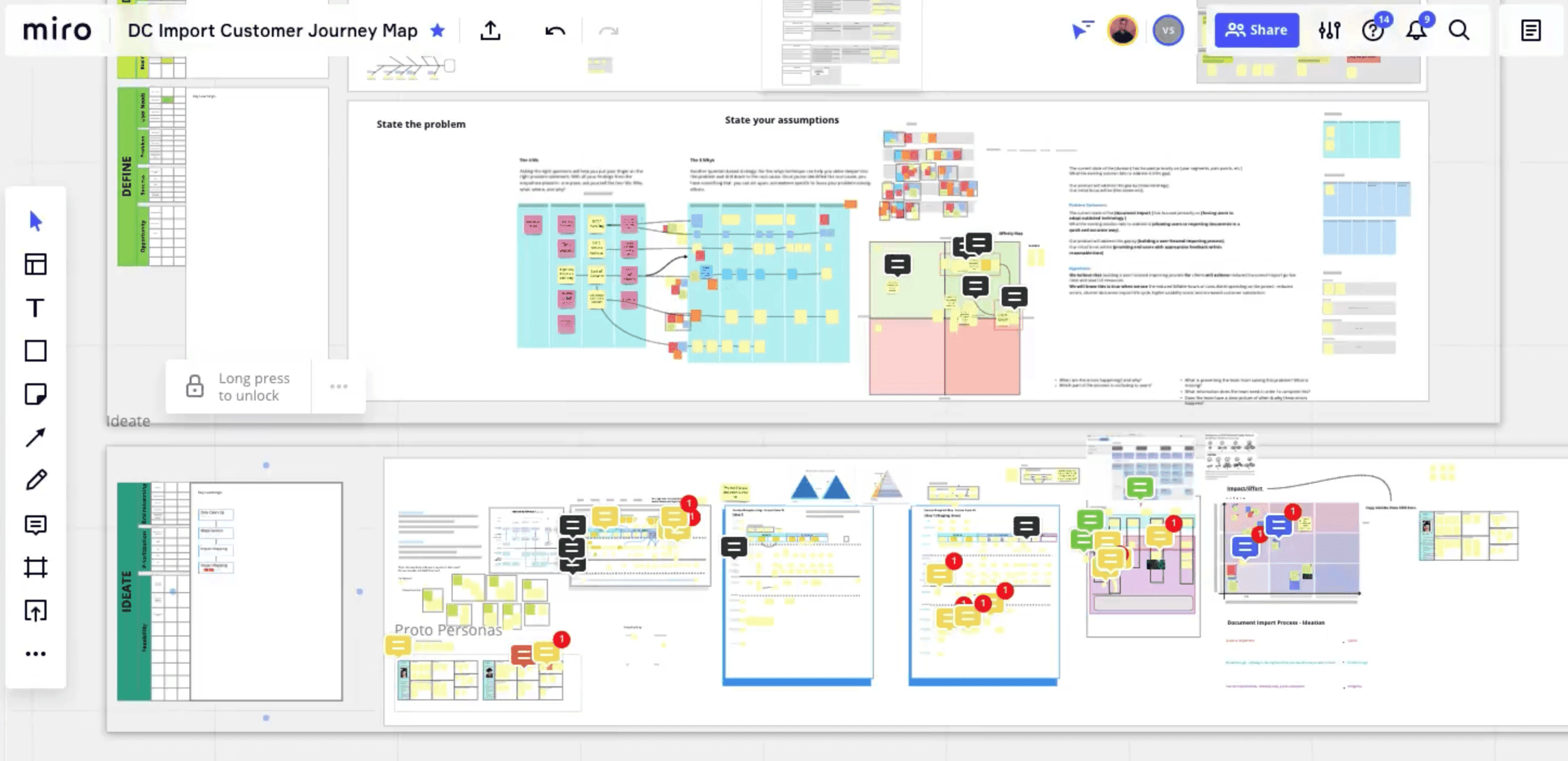 Enlarge
The current [document import] process forces users to adapt to old and clunky V5, neglecting the need for a quick and accurate way to import documents. Our product will close this gap by building a user-focused importing process — with end-users receiving appropriate feedback within reasonable time.
"A visual journey of our discovery and ideation process, capturing the evolving understanding of user needs and workflows."
"Flow notes of old version V5 by our dev lead team, laying the groundwork for seamless integration and development."
Breathing
New Life In
To kick off the concept ideation phase, we defined design principles that required the experience to be autonomous, adaptive, and integrated.
"We needed a more holistic experience that allowed users to discover related content to support their learning journey."
Autonomous
Empower users to self-serve through clear, guided workflows that reduce dependence on support agents at every step of the import process.
Adaptive
Cater to diverse client contexts and data structures, ensuring the system handles variation gracefully without forcing users to bend to legacy constraints.
Integrated
Seamlessly connect documents, metadata, and feedback loops so the experience feels cohesive — not like a bolt-on import tool grafted onto a legacy system.
Further, Higher, Faster — together
I am extremely proud of this project and its growth. The dev team's willingness to step outside their comfort zone was commendable — it allowed us to ask different, critical questions that drove progress even further.
The team's thorough assessment of the current state was a vital step toward success. Though it took time, confidence grew as our shared understanding deepened — making it much easier to plan forward and break down the blueprint maps into future state scenarios.
The strong bond formed with Matt, the Product Owner, through our team sessions was a crucial element in our success. Transparency around approaches, perspectives, and goals let us align, share, and plan the trajectory of the project together.
 Enlarge
A Video I Produced for the Product Town Hall
I conceived, scripted, and produced a short film presented at the Product Town Hall — showcasing how we shifted from a sales-driven model to one deeply rooted in the voice of the customer and UX methodologies.
This video was a turning point — sparking broader discussions and encouraging process improvements across the company. It broke down silos, promoted transparency, and empowered teams to adopt more agile practices — fostering a culture of collaboration and continuous improvement.
Voices from the team
The project's success was built on trust, transparency, and a shared commitment to the user. Here's how the people who were there describe the experience.
"Before UX involvement, user adoption was low. But using the UX playbook guided by Chris and Vicky, we captured user feedback early to level set and build our foundations out with greater confidence, and defensible evidence that justified our team direction."
"He brings a passion to everything he does, which is infectious. Chris is driven by a desire to keep digging deep into the hows and whys of every initiative. He is fearless even when tackling something new. He is definitely a strong value add to any UX organization."
"Chris is a passionate designer with excellent interpersonal skills who always strives to make the design process transparent and welcoming. I can always rely on Chris to deliver on-time and to a high standard — no matter the complexity or ambiguity."
Designing Success
Take a look at how I collaborate with teams across diverse industries — bridging research, strategy, and craft to ship products that matter.


Redefining
Enterprise
Onboarding
Intelex's document import process was broken by design. Client onboarding stretched to 6 months at its worst, burning consultant hours and eroding trust. I redesigned the experience from the ground up.
The outcome
From NO to WOAH!!
Before
17%
Customer satisfaction on CSAT — critically low, signalling systemic friction in the onboarding experience.
After
92%
Customer satisfaction post-redesign — eliminating the friction points that blocked client success.
Impact
441%
Increase in customer satisfaction on CSAT — one of the most significant UX-driven improvements in Intelex history.
Measuring Impact
Working with my UX colleauge Ashley Di Battista, we validated the measurement approach. She caught a critical framing issue: the draft metric didn't reflect the severity of the problem my team inherited.
The correction
Client satisfaction was at 17% when we started — not 62%. The system wasn't underperforming. It was broken.
Validated metrics
CSAT: 17% → 92% · 441% relative increase
Time to value: 6 months → 72 hours · 98% reduction
Here's the solution.
After months of discovery, blueprinting, and iteration — a new document import experience that cut time-to-value from six months down to days.
Replace a broken import process and restore client confidence
As UX Designer, my goal was to replace the outdated document import control process with a new, efficient system. The previous approach relied on a combination of two legacy projects, creating a fragile, error-prone experience that hurt clients and the business alike.
Working with the Product Owner, Lead Developer, and dev team, we developed a new system focused on ease of use, reliability, and effective support for document and metadata import — reducing time-to-value for every new client.
Product Owner · UX Researcher · UX Designer (Me) · Engineering Lead · Dev team
Identifying the core problems through research & discovery
Through surveys and interviews, we discovered critical issues and trends. This deep understanding allowed us to develop targeted strategies to tackle the challenges head-on.
Up to 6 Months
to Go Live
Getting documents, files, and client data ready for import into the Intelex platform would take weeks, and in worst cases up to 6 months — long before clients saw any value from their purchase.
Unbillable Hours
Piling Up
Customer support team agents were consumed by clients unable to get documents into the system. Constant back-and-forth between CST and clients compounded delays and costs at every step.
Enlarge"Before UX involvement, user adoption was low. Releases would come back needing an improvement package, or we find out 6 months later that the direction wasn't working for clients." — Matt Conquer, Product Owner
Activities & Outputs
Stakeholder & user interviews, problem statement workshop
Root cause analysis, VOC research, target customer mapping
Cross-functional workshops with Product, Research & Engineering
Impact & effort analysis, vertical slicing with Product Owner
Task flow concept, design principles definition
Mid-to-high fidelity flow in Adobe XD
Our UX Research Lead Vicky led the research effort while I focused on root cause analysis. Together we ran blueprinting workshops with leads across Product, Research, and Engineering — building a shared understanding that let us move faster with confidence.
Enlarge EnlargeThe current [document import] process forces users to adapt to old and clunky V5, neglecting the need for a quick and accurate way to import documents. Our product will close this gap by building a user-focused importing process — with end-users receiving appropriate feedback within reasonable time.
"A visual journey of our discovery and ideation process, capturing the evolving understanding of user needs and workflows."
"Flow notes of old version V5 by our dev lead team, laying the groundwork for seamless integration and development."
Breathing
New Life In
To kick off the concept ideation phase, we defined design principles that required the experience to be autonomous, adaptive, and integrated.
"We needed a more holistic experience that allowed users to discover related content to support their learning journey."
Autonomous
Empower users to self-serve through clear, guided workflows that reduce dependence on support agents at every step of the import process.
Adaptive
Cater to diverse client contexts and data structures, ensuring the system handles variation gracefully without forcing users to bend to legacy constraints.
Integrated
Seamlessly connect documents, metadata, and feedback loops so the experience feels cohesive — not like a bolt-on import tool grafted onto a legacy system.
Further, Higher, Faster — together
I am extremely proud of this project and its growth. The dev team's willingness to step outside their comfort zone was commendable — it allowed us to ask different, critical questions that drove progress even further.
The team's thorough assessment of the current state was a vital step toward success. Though it took time, confidence grew as our shared understanding deepened — making it much easier to plan forward and break down the blueprint maps into future state scenarios.
The strong bond formed with Matt, the Product Owner, through our team sessions was a crucial element in our success. Transparency around approaches, perspectives, and goals let us align, share, and plan the trajectory of the project together.
EnlargeA Video I Produced for the Product Town Hall
I conceived, scripted, and produced a short film presented at the Product Town Hall — showcasing how we shifted from a sales-driven model to one deeply rooted in the voice of the customer and UX methodologies.
This video was a turning point — sparking broader discussions and encouraging process improvements across the company. It broke down silos, promoted transparency, and empowered teams to adopt more agile practices — fostering a culture of collaboration and continuous improvement.
Voices from the team
The project's success was built on trust, transparency, and a shared commitment to the user. Here's how the people who were there describe the experience.
"Before UX involvement, user adoption was low. But using the UX playbook guided by Chris and Vicky, we captured user feedback early to level set and build our foundations out with greater confidence, and defensible evidence that justified our team direction."
"He brings a passion to everything he does, which is infectious. Chris is driven by a desire to keep digging deep into the hows and whys of every initiative. He is fearless even when tackling something new. He is definitely a strong value add to any UX organization."
"Chris is a passionate designer with excellent interpersonal skills who always strives to make the design process transparent and welcoming. I can always rely on Chris to deliver on-time and to a high standard — no matter the complexity or ambiguity."
Designing Success
Take a look at how I collaborate with teams across diverse industries — bridging research, strategy, and craft to ship products that matter.