Unity Docs.
From Chaos
to Cohesion.
3 million+ documentation pages across 73+ fragmented portals. Developers couldn't find what they needed, and 23% of Unity's user base was actively detracting from the platform. I was brought in to build a unified experience from the ground up.

Revolutionise discovery, search & consumption across 3M+ pages
Unity's developer documentation served 62,000 daily active users — and three previous initiatives had attempted to modernize it. Each stalled, launched without the dedicated design, research, and product resourcing needed to see them through.
The fourth attempt reframed the question entirely: stop treating documentation as a publishing problem and start treating it as a product. That shift is what brought me in.
My selection involved alignment across four management teams and the Director of Product Design — an unusual level of coordination that reflected how critical this initiative was. As the sole design lead, I set out to unify the fragmented end-user experience: introducing consistent UX, robust search, and clear documentation processes to reduce resolution times for millions of developers worldwide.
Senior Product Manager · Engineering Lead · Tech Program Manager · Director, Content & Documentation · Manager, Content Ops
The team assembled to solve it.
 Enlarge
 Enlarge
The solution
Here's what we built
Identifying the core problems through research & discovery
I began with the UX Research team's intensive prior study — a 1,400-participant research effort conducted the year before I joined — using it as a compass to ensure that underrepresented learning styles were at the forefront of all the work ahead. Building on that foundation, I conducted internal subject matter expert interviews to surface additional critical issues and trends, which together allowed me to develop targeted strategies to tackle the challenges head-on and build conviction with leadership.
Fragmented User Experience
Inconsistent UX, scattered documentation, and missing key features left users without a cohesive path to find answers. Processes and ownership of content were unclear and siloed.
23% of Users Detracted
Nearly a quarter of Unity's user base was being driven away from the platform specifically because of poor documentation experiences and support ticket overload.
73+ Different Portals & Sites
A content organisation of 7 pods with 5–7 writers each had independently built 73+ sub-sites — no consistent brand, no unified navigation, no Unity.
What the evidence said
The platform wasn't failing through lack of content — it was failing through infrastructure. The site's search index was built from a manually maintained Word document. One stakeholder described the experience as something from a different era of computing entirely. Three independent lines of evidence from user surveys, stakeholder interviews, and competitive analysis all pointed to the same structural truth.
 Enlarge
Activities & Outputs — a deeply collaborative process
Our process was deeply collaborative — spanning discovery, synthesis, ideation, and delivery. Click any activity to expand evidence and outputs.
Building shared understanding across content, product, and engineering leadership
Benchmarking against Stripe, AWS, and GitHub developer docs
Mapping where developers got stuck, gave up, or filed support tickets
Redesigning the IA for a documentation platform spanning 3M+ pages
Validated search patterns, navigation models, and content hierarchy
Securing stakeholder buy-in and handing off production-ready specs
Users weren't failing because the content didn't exist — they were failing because they couldn't find it. Navigation and search were the core unlocks, not content volume.
“It’s great that you’re doing this because it’ll help the group come together and start capital momentum.”
“Running a workshop with the Docs Leads was a crucial step to ensure everyone was on the same page.”
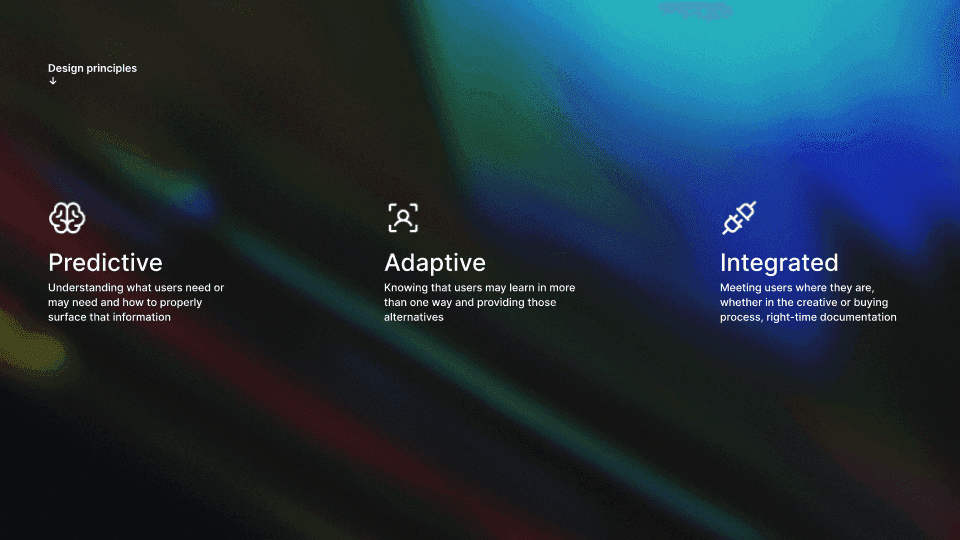
Forging our principles
Before pixels, we needed principles. These three became our north star throughout every design decision — from IA to interaction to information density.
“Every decision we made had to pass a simple test: does this make it faster and easier for a developer to solve their problem?”
Predictive
Understanding what users need or may need and how to properly surface that information — before they know to ask for it.
Adaptive
Knowing that users may learn in more than one way and providing those alternatives — whether through video, interactive examples, or written reference.
[Directly informed by the research team's learning modalities study]Integrated
Meeting users where they are — whether in the creative or buying process. Right-time documentation that fits into the workflow, not alongside it.
 Enlarge
Building Trust Through Transparent Communication
Context
Unity's documentation initiative was launching for the fourth time after three failed attempts. Technical writers, content teams, and developers had been burned before—skepticism was high, and trust needed rebuilding.
My Approach
I treated town halls as collaborative checkpoints, not presentations. Every quarter, I presented current state, design prototypes, and research findings to C-level executives (CTO, VP of Product), directors, and ICs across disciplines. These were working sessions designed to create transparency and invite real-time feedback.
What Made It Work
I framed sessions around Unity's core values: "Best ideas win" and "We're in it together." I showed high-fidelity prototypes alongside the research that informed them, explained design decisions, and asked: "This is where we're at. What are your thoughts?" The goal was rebuilding trust by proving we were listening.
The Result
Across six company-wide town halls, I presented to audiences from technical writers to C-suite. Sessions generated constructive feedback that shaped our roadmap, surfaced cross-functional dependencies, and transformed a legacy of failed initiatives into organizational buy-in. I learned to navigate skepticism, manage diverse stakeholder expectations, and communicate complex design decisions to non-design audiences.
"Transparency isn't about having all the answers—it's about showing your work, inviting feedback, and proving people's voices matter."
 Enlarge
 Enlarge
What we shipped — and what changed
We launched a unified documentation hub that replaced 73+ fragmented portals with a single, coherent experience. A new global search — with relevance ranking and contextual filtering — became the backbone of the product.
I introduced a standardised navigation system and content taxonomy that let the content team scale without chaos. Every page shared the same structure, the same tone, and the same visual language.
The impact was measurable and fast. Within 90 days of launch, support ticket volume dropped, session depth increased, and satisfaction scores climbed — for the first time in years.
 Enlarge
Designing for the Long Game
Search is infrastructure, not a feature. Investing there first unlocked everything downstream.
IA decisions are product decisions. The structure of content directly shapes how users perceive capability.
Cross-functional ownership was the hardest and most important part. Design couldn't solve this alone.
Measuring the right thing matters. Tickets and NPS told a story that page views never could.
Vendor decisions are design decisions. Evaluating Algolia vs. Coveo in parallel with the IA work ensured the design system could support either implementation path — a detail that kept engineering unblocked.
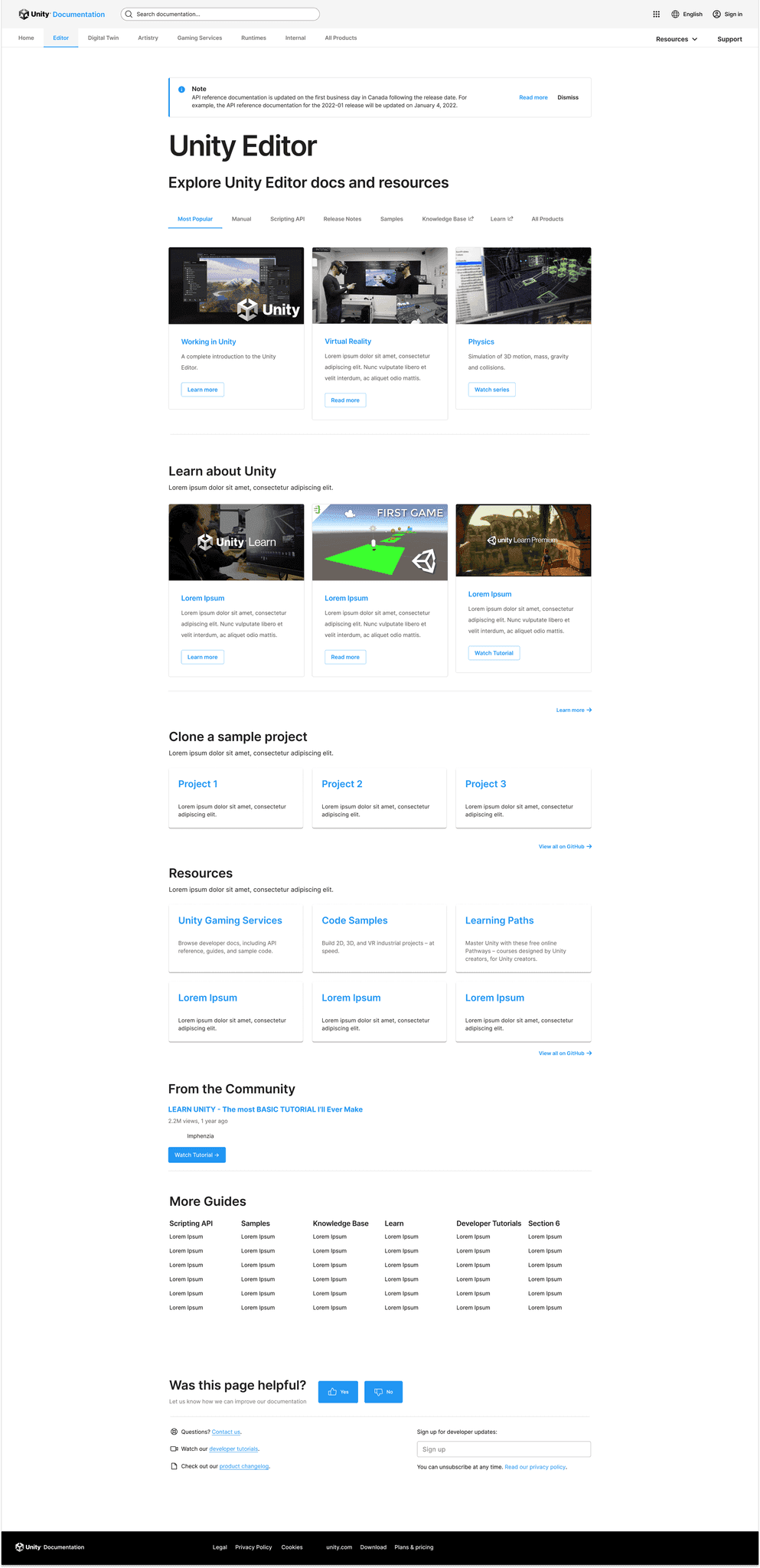
Final Screens before Handoff
to Anton's Engineers
 Enlarge
 Enlarge
 Enlarge
A unified experience, built to last
I was thrilled to build and refine this new information experience for our customers — and to deliver what three previous initiatives could not. Collaborating with Brian (Senior Technical Program Manager), Anton (Lead Engineer), and the entire CIX team, I'm confident the “Guardian” Design System will bring immense value to game development teams — a direct result of the learning experience improvements I designed, informed by the UX Research team's previous-year study, for many years to come.
We were in continuous development with a working live environment. The latest screens showcased a unified, streamlined design that ensured consistency across all documentation sites.
Focusing on the creator authoring pipeline was crucial to eliminating blockers and redundancies in documentation. Close collaboration with creator and developer teams helped identify pain points and streamline workflows.
Words from my teammates and leaders




Designing Success
Take a look at how I collaborate with teams across diverse industries — bridging research, strategy, and craft to ship products that matter.

Unity Docs.
From Chaos
to Cohesion.
3 million+ documentation pages across 73+ fragmented portals. Developers couldn't find what they needed, and 23% of Unity's user base was actively detracting from the platform. I was brought in to build a unified experience from the ground up.
Revolutionise discovery, search & consumption across 3M+ pages
Unity's developer documentation served 62,000 daily active users — and three previous initiatives had attempted to modernize it. Each stalled, launched without the dedicated design, research, and product resourcing needed to see them through.
The fourth attempt reframed the question entirely: stop treating documentation as a publishing problem and start treating it as a product. That shift is what brought me in.
My selection involved alignment across four management teams and the Director of Product Design — an unusual level of coordination that reflected how critical this initiative was. As the sole design lead, I set out to unify the fragmented end-user experience: introducing consistent UX, robust search, and clear documentation processes to reduce resolution times for millions of developers worldwide.
Senior Product Manager · Engineering Lead · Tech Program Manager · Director, Content & Documentation · Manager, Content Ops
The team assembled to solve it.
Enlarge EnlargeThe solution
Here's what we built
Identifying the core problems through research & discovery
I began with the UX Research team's intensive prior study — a 1,400-participant research effort conducted the year before I joined — using it as a compass to ensure that underrepresented learning styles were at the forefront of all the work ahead. Building on that foundation, I conducted internal subject matter expert interviews to surface additional critical issues and trends, which together allowed me to develop targeted strategies to tackle the challenges head-on and build conviction with leadership.
Fragmented User Experience
Inconsistent UX, scattered documentation, and missing key features left users without a cohesive path to find answers. Processes and ownership of content were unclear and siloed.
23% of Users Detracted
Nearly a quarter of Unity's user base was being driven away from the platform specifically because of poor documentation experiences and support ticket overload.
73+ Different Portals & Sites
A content organisation of 7 pods with 5–7 writers each had independently built 73+ sub-sites — no consistent brand, no unified navigation, no Unity.
What the evidence said
The platform wasn't failing through lack of content — it was failing through infrastructure. The site's search index was built from a manually maintained Word document. One stakeholder described the experience as something from a different era of computing entirely. Three independent lines of evidence from user surveys, stakeholder interviews, and competitive analysis all pointed to the same structural truth.
EnlargeActivities & Outputs — a deeply collaborative process
Our process was deeply collaborative — spanning discovery, synthesis, ideation, and delivery. Click any activity to expand evidence and outputs.
Building shared understanding across content, product, and engineering leadership
Benchmarking against Stripe, AWS, and GitHub developer docs
Mapping where developers got stuck, gave up, or filed support tickets
Redesigning the IA for a documentation platform spanning 3M+ pages
Validated search patterns, navigation models, and content hierarchy
Securing stakeholder buy-in and handing off production-ready specs
Users weren't failing because the content didn't exist — they were failing because they couldn't find it. Navigation and search were the core unlocks, not content volume.
“It’s great that you’re doing this because it’ll help the group come together and start capital momentum.”
“Running a workshop with the Docs Leads was a crucial step to ensure everyone was on the same page.”
Forging our principles
Before pixels, we needed principles. These three became our north star throughout every design decision — from IA to interaction to information density.
“Every decision we made had to pass a simple test: does this make it faster and easier for a developer to solve their problem?”
Predictive
Understanding what users need or may need and how to properly surface that information — before they know to ask for it.
Adaptive
Knowing that users may learn in more than one way and providing those alternatives — whether through video, interactive examples, or written reference.
[Directly informed by the research team's learning modalities study]Integrated
Meeting users where they are — whether in the creative or buying process. Right-time documentation that fits into the workflow, not alongside it.
EnlargeBuilding Trust Through Transparent Communication
Context
Unity's documentation initiative was launching for the fourth time after three failed attempts. Technical writers, content teams, and developers had been burned before—skepticism was high, and trust needed rebuilding.
My Approach
I treated town halls as collaborative checkpoints, not presentations. Every quarter, I presented current state, design prototypes, and research findings to C-level executives (CTO, VP of Product), directors, and ICs across disciplines. These were working sessions designed to create transparency and invite real-time feedback.
What Made It Work
I framed sessions around Unity's core values: "Best ideas win" and "We're in it together." I showed high-fidelity prototypes alongside the research that informed them, explained design decisions, and asked: "This is where we're at. What are your thoughts?" The goal was rebuilding trust by proving we were listening.
The Result
Across six company-wide town halls, I presented to audiences from technical writers to C-suite. Sessions generated constructive feedback that shaped our roadmap, surfaced cross-functional dependencies, and transformed a legacy of failed initiatives into organizational buy-in. I learned to navigate skepticism, manage diverse stakeholder expectations, and communicate complex design decisions to non-design audiences.
"Transparency isn't about having all the answers—it's about showing your work, inviting feedback, and proving people's voices matter."
Enlarge EnlargeWhat we shipped — and what changed
We launched a unified documentation hub that replaced 73+ fragmented portals with a single, coherent experience. A new global search — with relevance ranking and contextual filtering — became the backbone of the product.
I introduced a standardised navigation system and content taxonomy that let the content team scale without chaos. Every page shared the same structure, the same tone, and the same visual language.
The impact was measurable and fast. Within 90 days of launch, support ticket volume dropped, session depth increased, and satisfaction scores climbed — for the first time in years.
EnlargeDesigning for the Long Game
Search is infrastructure, not a feature. Investing there first unlocked everything downstream.
IA decisions are product decisions. The structure of content directly shapes how users perceive capability.
Cross-functional ownership was the hardest and most important part. Design couldn't solve this alone.
Measuring the right thing matters. Tickets and NPS told a story that page views never could.
Vendor decisions are design decisions. Evaluating Algolia vs. Coveo in parallel with the IA work ensured the design system could support either implementation path — a detail that kept engineering unblocked.
Final Screens before Handoff
to Anton's Engineers
Enlarge Enlarge EnlargeA unified experience, built to last
I was thrilled to build and refine this new information experience for our customers — and to deliver what three previous initiatives could not. Collaborating with Brian (Senior Technical Program Manager), Anton (Lead Engineer), and the entire CIX team, I'm confident the “Guardian” Design System will bring immense value to game development teams — a direct result of the learning experience improvements I designed, informed by the UX Research team's previous-year study, for many years to come.
We were in continuous development with a working live environment. The latest screens showcased a unified, streamlined design that ensured consistency across all documentation sites.
Focusing on the creator authoring pipeline was crucial to eliminating blockers and redundancies in documentation. Close collaboration with creator and developer teams helped identify pain points and streamline workflows.
Words from my teammates and leaders
Designing Success
Take a look at how I collaborate with teams across diverse industries — bridging research, strategy, and craft to ship products that matter.
Unity Docs.
From Chaos
to Cohesion.
3 million+ documentation pages across 73+ fragmented portals. Developers couldn't find what they needed, and 23% of Unity's user base was actively detracting from the platform. I was brought in to build a unified experience from the ground up.
Revolutionise discovery, search & consumption across 3M+ pages
Unity's developer documentation served 62,000 daily active users — and three previous initiatives had attempted to modernize it. Each stalled, launched without the dedicated design, research, and product resourcing needed to see them through.
The fourth attempt reframed the question entirely: stop treating documentation as a publishing problem and start treating it as a product. That shift is what brought me in.
My selection involved alignment across four management teams and the Director of Product Design — an unusual level of coordination that reflected how critical this initiative was. As the sole design lead, I set out to unify the fragmented end-user experience: introducing consistent UX, robust search, and clear documentation processes to reduce resolution times for millions of developers worldwide.
Senior Product Manager · Engineering Lead · Tech Program Manager · Director, Content & Documentation · Manager, Content Ops
The team assembled to solve it.
Enlarge EnlargeThe solution
Here's what we built
Identifying the core problems through research & discovery
I began with the UX Research team's intensive prior study — a 1,400-participant research effort conducted the year before I joined — using it as a compass to ensure that underrepresented learning styles were at the forefront of all the work ahead. Building on that foundation, I conducted internal subject matter expert interviews to surface additional critical issues and trends, which together allowed me to develop targeted strategies to tackle the challenges head-on and build conviction with leadership.
Fragmented User Experience
Inconsistent UX, scattered documentation, and missing key features left users without a cohesive path to find answers. Processes and ownership of content were unclear and siloed.
23% of Users Detracted
Nearly a quarter of Unity's user base was being driven away from the platform specifically because of poor documentation experiences and support ticket overload.
73+ Different Portals & Sites
A content organisation of 7 pods with 5–7 writers each had independently built 73+ sub-sites — no consistent brand, no unified navigation, no Unity.
What the evidence said
The platform wasn't failing through lack of content — it was failing through infrastructure. The site's search index was built from a manually maintained Word document. One stakeholder described the experience as something from a different era of computing entirely. Three independent lines of evidence from user surveys, stakeholder interviews, and competitive analysis all pointed to the same structural truth.
EnlargeActivities & Outputs — a deeply collaborative process
Our process was deeply collaborative — spanning discovery, synthesis, ideation, and delivery. Click any activity to expand evidence and outputs.
Building shared understanding across content, product, and engineering leadership
Benchmarking against Stripe, AWS, and GitHub developer docs
Mapping where developers got stuck, gave up, or filed support tickets
Redesigning the IA for a documentation platform spanning 3M+ pages
Validated search patterns, navigation models, and content hierarchy
Securing stakeholder buy-in and handing off production-ready specs
Users weren't failing because the content didn't exist — they were failing because they couldn't find it. Navigation and search were the core unlocks, not content volume.
“It’s great that you’re doing this because it’ll help the group come together and start capital momentum.”
“Running a workshop with the Docs Leads was a crucial step to ensure everyone was on the same page.”
Forging our principles
Before pixels, we needed principles. These three became our north star throughout every design decision — from IA to interaction to information density.
“Every decision we made had to pass a simple test: does this make it faster and easier for a developer to solve their problem?”
Predictive
Understanding what users need or may need and how to properly surface that information — before they know to ask for it.
Adaptive
Knowing that users may learn in more than one way and providing those alternatives — whether through video, interactive examples, or written reference.
[Directly informed by the research team's learning modalities study]Integrated
Meeting users where they are — whether in the creative or buying process. Right-time documentation that fits into the workflow, not alongside it.
EnlargeBuilding Trust Through Transparent Communication
Context
Unity's documentation initiative was launching for the fourth time after three failed attempts. Technical writers, content teams, and developers had been burned before—skepticism was high, and trust needed rebuilding.
My Approach
I treated town halls as collaborative checkpoints, not presentations. Every quarter, I presented current state, design prototypes, and research findings to C-level executives (CTO, VP of Product), directors, and ICs across disciplines. These were working sessions designed to create transparency and invite real-time feedback.
What Made It Work
I framed sessions around Unity's core values: "Best ideas win" and "We're in it together." I showed high-fidelity prototypes alongside the research that informed them, explained design decisions, and asked: "This is where we're at. What are your thoughts?" The goal was rebuilding trust by proving we were listening.
The Result
Across six company-wide town halls, I presented to audiences from technical writers to C-suite. Sessions generated constructive feedback that shaped our roadmap, surfaced cross-functional dependencies, and transformed a legacy of failed initiatives into organizational buy-in. I learned to navigate skepticism, manage diverse stakeholder expectations, and communicate complex design decisions to non-design audiences.
"Transparency isn't about having all the answers—it's about showing your work, inviting feedback, and proving people's voices matter."
Enlarge EnlargeWhat we shipped — and what changed
We launched a unified documentation hub that replaced 73+ fragmented portals with a single, coherent experience. A new global search — with relevance ranking and contextual filtering — became the backbone of the product.
I introduced a standardised navigation system and content taxonomy that let the content team scale without chaos. Every page shared the same structure, the same tone, and the same visual language.
The impact was measurable and fast. Within 90 days of launch, support ticket volume dropped, session depth increased, and satisfaction scores climbed — for the first time in years.
EnlargeDesigning for the Long Game
Search is infrastructure, not a feature. Investing there first unlocked everything downstream.
IA decisions are product decisions. The structure of content directly shapes how users perceive capability.
Cross-functional ownership was the hardest and most important part. Design couldn't solve this alone.
Measuring the right thing matters. Tickets and NPS told a story that page views never could.
Vendor decisions are design decisions. Evaluating Algolia vs. Coveo in parallel with the IA work ensured the design system could support either implementation path — a detail that kept engineering unblocked.
Final Screens before Handoff
to Anton's Engineers
Enlarge Enlarge EnlargeA unified experience, built to last
I was thrilled to build and refine this new information experience for our customers — and to deliver what three previous initiatives could not. Collaborating with Brian (Senior Technical Program Manager), Anton (Lead Engineer), and the entire CIX team, I'm confident the “Guardian” Design System will bring immense value to game development teams — a direct result of the learning experience improvements I designed, informed by the UX Research team's previous-year study, for many years to come.
We were in continuous development with a working live environment. The latest screens showcased a unified, streamlined design that ensured consistency across all documentation sites.
Focusing on the creator authoring pipeline was crucial to eliminating blockers and redundancies in documentation. Close collaboration with creator and developer teams helped identify pain points and streamline workflows.
Words from my teammates and leaders
Designing Success
Take a look at how I collaborate with teams across diverse industries — bridging research, strategy, and craft to ship products that matter.